((Images can be clicked to expand / scrolled and there’s some other funky stuff – thank you GPT for teaching me and helping write HTML style sheets for this article. Thank you Charlie, Wilbur and others for submitting photos and logs and well. Well done all!))
Getting Started
I went to Crackchella prepared to document a mess, albeit with some good music expected from some of the acts. The ‘irritating’ (not really) thing is that they made me document an actual festival. An actual festival with generally good music. Hathian, wow… You’ve actually outdone yourself.
From the Observer’s specially built tower above Batterie Beach, it was difficult to pretend this was anything other than successful. Not that, as your chronicler, I want you to fail; it’s more that I expect some of you to fail to behave and that often creates great (profitable) photographs. Never mind. There was more than enough for me anyway, and I am sure I missed things through the simple disadvantage of spending so much of the day staring through a camera lens.
So what was there? A proper stage looming over the sand in electric pinks, purples and blues, lighting rigs and speakers, fenced performance space, bars, food stalls, merchandise, a VIP area and enough people steadily filling the gaps between them that our camera crew eventually sent the drone up simply to get the whole thing into one frame. One of the few times a drone wasn’t immediately shot down in Hathian. Beyond it all was the Gulf, offensively picturesque beneath an August sky while Hathian busied itself below with the important work of getting drunk, drugged and danced with.

The Great Choreographer
At the centre of proceedings, geographically when he could manage it and spiritually whether anyone wanted him there or not, was Wilbur ‘Fitz’ Fitzgerald. Fitz had equipped himself with a megaphone, balloon appendages, very little shame and an absolute conviction that festival promotion required continuous shouting and frequently wriggling his butt backwards and forwards while standing on a rock, possibly with his rocks jiggling around as well. Not the kind of photo Stanley pays me for, but still… very Hathian.

Before the first artist had even played, Lt. Blackheart was demanding to see his permits. Fitz’s eventual solution was to descend from his beloved Crack Rock and offer her VIP passes while describing them, with considerable optimism, as his paperwork. This did not noticeably improve my confidence in the regulatory framework underpinning the day, although it did seem to pacify Vanora. I guess she had to get something off her chest cop-related, seeing as her chest very much didn’t look cop-duty uniform. (Yum?)
Usually Security Ask About Your Bag…
I had previewed Crackchella as Hathian’s answer to the great summer music festival: local artists, vendors, booze, questionable substances, costumes, beach heat and VIP hospitality. What was actually delivered was all of that and more, including ‘security’ personnel being unusually enthusiastic about giving guests small black bags.
By eleven in the morning, the Saint-James stall was pouring wine and sake, the other vendors were getting into position, the crowd was thickening and someone was openly advertising “party favours” containing interesting substances that the Observer won’t name here in case it pushes more of you towards the pushers. Fitz, naturally, was directing festival-goers towards the men in security shirts because they “might have something for you.”


The Observer had its raised media position, although staying safely inside it would rather have defeated the purpose and also not allowed me to drink and sample stuff. I spent the day moving between the tower, stage, stalls and VIP enclosure, taking photographs and collecting whatever snippets of the usual Hathian gossip survived the music while the crew covered the wider view from above. There were inflatable animals, elaborate outfits, people making enthusiastic use of one another, drugs being distributed and, breaking through all of it, an actual programme of musicians who had turned up intending to be heard.
That part matters. Crackchella could very easily have been remembered only for the spectacle around the stage. Instead, the stage kept earning our attention back.
Getting Into It
Kara walked out alone with her guitar and loop pedal. Kenzie followed her nerves onto the boards and discovered what happened once the music started. Nicky Rose took the first turn behind the decks, Valor brought guitar and theatricality, Karigan Hopper returned us to the dancefloor, Witchouse arrived as a full band, AY$3 turned autobiography into performance, Mel sang Hathian back at itself and Isla Hawthorn carried the programme towards its close.
Around them, Fitz continued to bellow… People continued to drink… The drugs continued to be alarmingly complimentary.


And Crackchella, against several quite reasonable expectations, continued to work. It was messy, vulgar, chemically adventurous and occasionally organised according to principles that seemed to radiate from Wilbur’s jiggling arse. It was also crowded, ambitious, musically varied and unmistakably alive.
So yes, Fitz. You did it.
Now let us discuss what everyone else did with your stage.
Artist Review
Kara
There is something mildly cruel about being given the eleven o’clock opening slot at a festival. The crowd is still arriving, the bars are only beginning their day’s campaign against functioning livers and half the people in front of you are working out where the toilets are. You do not inherit an atmosphere. You have to make one.
Kara walked onto a very large stage with no dancers and no band, just a guitar, microphone and loop pedal, made a heart towards the gathering crowd and introduced herself with charming simplicity: “Hi, I’m Kara.” Then she told us she had written the opening song especially for Crackchella.

It was called Batterie Blue, built up through guitar and looped effects into the sort of dreamy, floating harmonics that suited Batterie Beach rather beautifully. At eleven in the morning, with the Gulf behind the festival and people still filtering between stalls, it didn’t try to pretend we were six hours further into proceedings than we actually were. It eased the place awake. No explosion, no troupe of backing dancers, no desperate demand that Hathian immediately prove how hard it could party.
That gentleness did not last long.
Pool Thoughts followed with a jauntier, chilled-out sound before Kara abruptly reminded anyone tempted to put her into the pleasant-blonde-with-guitar box that she had other ideas. A song about her hair and how, in her words, “a real blonde will frick your life up” came with a much darker industrial guitar riff, headbanging and enough movement from those spiked bunches that I briefly wondered whether they should have been listed on the risk assessment.
There was humour threaded through the set too. Kara invited the crowd into a chorus involving boomers; Fitz, incapable of allowing an invitation to audience participation to pass without inserting himself bodily into it, began yelling about Facebook rants and the unaffordability of houses. At another point he became loudly and urgently concerned that somebody was going to hurt a dog. Following Crackchella solely through Fitz’s commentary would not have left you with an accurate understanding of Kara’s songwriting, but it would certainly have left you with an understanding.
Kara slowed things down for Breathing Room, written following the recent fire on the CU campus, before returning to considerably less subtle territory with her signature A Little Bit Kara. By then the crowd had warmed with her: dancing around the VIP area, cheering from the beach, Bryce offering a very enthusiastic verdict and Fitz repeatedly attempting to become an unofficial backing vocalist from his rock. None of it swallowed Kara. She had begun alone on an oversized stage and twenty-odd minutes later looked perfectly entitled to it.
She finished shortly before half past eleven, bowed, gave Crackchella another heart and went off to find water before joining the audience herself. No smashed guitars. No pyrotechnic catastrophe. Nobody had to be carried off. She did not even swear much, something Isla Hawthorn appeared to find amusing and which at Crackchella probably qualified as experimental performance art.
It wasn’t my favourite set; a little sugary for Hathian and certainly for me. But Kara had the difficult job of turning an audience that was still assembling towards the stage, and she did it while moving from dreamy beach harmonics through chilled pop, industrial guitar, humour and something more reflective without losing the personality connecting it all.
A good way to wake the place up.
Kenzie
If Kara had the questionable privilege of waking Crackchella up, Kenzie had a different problem: by noon there was now an actual crowd to be frightened of.
A few minutes before she was due onstage, Kenzie described what was happening inside her stomach as “a bunch of moths on meth, squirming around in my belly.” When Fitz finally bellowed her name across Batterie Beach she arrived at the microphone with trembling hands, an uncertain little “Uh. So. Hello,” and an explanation which rapidly collapsed into: “Fuck it I’m just gonna start.”

In fairness, often the best available treatment for stage fright.
The change in those opening minutes was more interesting than the first song itself. Kenzie initially looked as though she might prefer the stage to open up and swallow her, but by Ride or Die she had the microphone out of its stand and was moving towards the front. Mollie and Daniel were loudly supporting her, Merrick forced his way closer with a particularly enthusiastic “YEEHAW! FUCK YEAH KENZIE!” and Bryce was similarly unwilling to keep his appreciation at a volume our cameras couldn’t pick up.
What a Shame came next, a brand-new track which Kenzie told Crackchella it was the first audience to hear. The hesitant introduction had already given way to someone visibly working the stage, sweating in the August heat and discovering that a crowd’s worth of eyes becomes considerably less terrifying once those eyes belong to people cheering back.


Then we reached the Kenzie Extended Universe of Poor Romantic Decisions.
One track was introduced as the one that “started it all”, aimed at Hathian’s apparently notorious Badge Bunny Breeder. Shortly afterwards came Captain Save a Ho, dedicated to the aforementioned bunny’s white knight and greeted from the crowd by a rhythmic chant of “DER-EK GHOST-LY!” I make no ruling on the underlying disputes, but we’ve had bunny cops before. RIP Lee.
This sort of material suited Kenzie. Her songs felt less like carefully sanitised pop lyrics and more like somebody had taken months of Bluesky arguments, bad relationships, in-jokes and conversations with friends, put them through a melody and decided everyone else could hear them too. There is danger in that, particularly in a city where the subject might be standing twenty feet from the stage, but it gave the set personality.
After what she called the ‘victory lap’ and final word on the Badge Bunny saga, she deliberately changed pace with Us Against the World, a newer song she had helped her brother write for his girlfriend. Kenzie asked the audience to find somebody’s hand and hold it. Coming after several songs whose emotional message could broadly be summarised as you know what you did, the sincerity should perhaps have jarred. It didn’t. Kenzie writes close to herself and the people around her, whether she’s mocking them, loving them or occasionally doing both at once.
For her final song she picked the safest possible subject for a peaceful conclusion: Hathian.
“It’s about the one thing we all have in common,” she told us.
Quite. There are many possible songs to write about Hathian, most of which probably require an explicit-content warning, a trauma counsellor or a defence lawyer, but it fitted Crackchella perfectly. This was an event built around the unlikely proposition that the city could take its feuds, addictions, romances, gangs, bad decisions and people who really shouldn’t have access to megaphones and turn them into something communal for a day.
Kenzie walked onto the stage visibly terrified and left a little over half an hour later hot, exhausted and grinning. Once back among Mollie and her male friend, the first thing she announced was simply: “I did it!”
She had. There were technically cleaner and more experienced performers still to come, but there is something difficult to manufacture about watching someone realise in real time that perhaps they belong on the stage after all.
And despite beginning with moths on meth, she hadn’t even vomited on it.
A successful debut by any reasonable Hathian metric.
DJ Nicky Rose
After two singers, Crackchella handed the stage over to somebody with a USB stick, microphone and apparently very firm opinions about wolves. DJ Nicky Rose made his way through the crowd shortly after half past twelve dressed in the sort of high-visibility festival gear that suggested either entertainer or emergency response depending on which direction you approached him from. He fought briefly with the barricade, climbed onto the stage and announced that his set was for “all the real cool cats and kittens who aren’t afraid to jump in a sand pit every now and then.”

There isn’t much point pretending to give you a song-by-song account of a DJ set. Nicky was mixing, working the controls and using the microphone intermittently to encourage increasingly questionable behaviour from the people below. His job was to take the momentum Kara and Kenzie had created and keep Batterie Beach moving for another hour.
Within minutes he had moved from manipulating highs, mids and lows to breathing heavily into the microphone and announcing, with the conviction of somebody revealing an important spiritual truth: “THERE IS A WOLF INSIDE OF YOU. LET IT OUT.”
Hathian, regrettably, did.


Howls went up around the festival. Fitz immediately contributed one because of course he did, while people danced through the VIP area and around the stalls. Nicky’s microphone interventions became a feature. At one point we were informed that eating an entire tub of ice cream alone was irrelevant provided one could, and I quote, “MAKE IT CLAP.” Later came an announcement for the “ladies in heat.” I am not entirely sure what musical genre requires this degree of audience instruction, but nobody below the Observer cameras appeared troubled.
At 1:31 he announced his final track, congratulated the crowd and requested somebody bring him a wing. Six minutes later Nicky disconnected from the decks and concluded his performance in the traditional manner expected of serious professional DJs.
He moonwalked off the stage…
Valor
After Nicky had successfully released whatever wolves Hathian was keeping inside itself, the stage moved back to live music. Valor arrived shortly before two with a guitar, cigarette, beer and energy drink, plugged into the amps, checked his pedals and announced himself with considerably fewer signs of impending stage fright than Kenzie had managed.
“Okay let’s fuckin’ do this.”

Valor told the crowd this was the largest concert he had played since Vegas, then proceeded to make the stage feel rather smaller by comparison. Where Kara had opened gently and Kenzie had grown into her performance, Valor began as though somebody had already turned everything to eleven: heavy guitar, long hair thrown around beneath the lights, vocals pushed hard over the amps and enough movement that Fitz was soon demanding a mosh pit from the VIP section.
This was getting closer to my preferred end of Crackchella. C’mon Hathian, you know how I dress and what I like.
The heavier material had teeth. One early song went directly after authority and the suppression of people seeking freedom, with Valor headbanging through a brutal guitar line while Fitz provided the useful critical observation that he had “pipes” and speculated whether this translated into other forms of pipe-laying. Somewhere, a professional music journalist presumably felt a disturbance in the force.

Valor then sat down on an amp, tuned more quietly and dedicated Bayou Breath to friends from the “ominous swampy towns with as many secrets as a witch’s house.” The attack gave way to something slower, smokier and deliberately atmospheric. That was where his set started working for me. Loud guitar is easy enough if all you intend to do is remain loud; Valor kept changing the character of it.
Cracks on the Porcelain came with a reflection on the masks people wear for employers, family, other people or simply because hiding eventually becomes habit. Porcelain cracks, he argued, and what you’ve hidden behind it eventually shows. The guitar moved with him into something more electronic rather than simply returning to the previous wall of noise. Given the number of people in Hathian walking around behind carefully maintained versions of themselves, his chances of hitting somebody in the audience were statistically excellent. Hello most of HPD, for example.
From there he swapped to semi-acoustic and dedicated a much more sombre song to “the fallen, the gone” and those no longer in our lives, arguing that constant loss leaves little time to properly honour people before life moves on. The aggression disappeared into something melancholy. Around the barrier there were people mouthing along and one listener becoming visibly emotional; elsewhere Caisen Mizuki was dancing hard enough to kick up dust and loudly offering his own review: “I love this Valor. Great music.”
For the finish, the claws came back out. Bricks and Badges was explicitly for Hathian and very plainly interested in authority. Valor grinned at the crowd, asked “You all know WHAT I am talking about with this eh?” and threw himself into a final guitar solo with hair flying and another change of effects beneath the last chorus.
I am the Editor of a newspaper. I am contractually obliged to pretend I have no idea why an anti-authority song might resonate locally. The crowd can draw its own conclusions.
Valor bowed out around half past two, breathing heavily, drinking from the Darkwire can beside his amp and directing anyone who wanted more towards his Bluesky before thanking both “Hathianites and Lauveunites” and jumping down from the stage.
He could easily have assaulted the beach with heavy guitar for half an hour and left me writing some variation of yes, very loud, thank you. Instead there was anger, swamp atmosphere, introspection, grief and then anger again. Not everything needed quite as much spoken explanation between songs, but when the music arrived the size of the Crackchella stage suddenly felt appropriate.
After Kara’s sweetness, Kenzie’s romantic warfare and an hour of Nicky instructing women in heat to release their inner wolf, a little proper darkness was overdue.
Much better.
DJ Karigan Hopper
Valor handed the stage back to the decks around quarter to three, and DJ Karigan Hopper introduced herself with perhaps the most efficient mission statement of the afternoon:
“Find someone delicious, pull them close, and forget civilization for a little while. Predators, prey… lovers, stranger… I don’t particularly care. Just make it interesting.”

Hathian required very little encouragement on any of those points.
Karigan settled behind the decks and, rather than competing with the live acts around her, let the festival spread outward again. People danced, wandered between the stage and vendors, climbed onto things they probably shouldn’t have been standing on and steadily lowered whatever standards of civilisation they had brought with them. Clivia apparently decided the appropriate place to enjoy part of Karigan’s set was from the roof of a truck. I married her voluntarily, so there is limited scope for complaint.
Musically this sat considerably closer to my end of the spectrum than some of the day’s brighter material: a heavier pulse, guitars working through the mix and Karigan gradually disappearing into it herself, moving behind the decks with the same slow rhythm she was feeding across the beach. By later in the set she was visibly soaked from the August heat and still going.
There was also considerably less microphone philosophy than Nicky had provided. No wolves were released. Nobody received instructions regarding tubs of ice cream. Karigan trusted the music and the people in front of her to work out what to do with each other.
Frankly, they managed.
She closed shortly before four with Whore by In This Moment, which is either excellent musical taste or an extremely accurate description of a measurable percentage of the Crackchella audience. Possibly both. Hello CU influencers.
As the stage crew began clearing the equipment, Karigan stepped aside in search of something to drink and Fitz announced that we had reached half-time.
Half-time… It had already been five hours…
Witchouse
Half-time apparently meant it was time to make everything louder. Just after four the stage went dark and Witchouse came out one member at a time: Rome Baptiste on bass, Noah Adler behind the electronics, Elias Vassos at the drum kit and Dane Holloway with guitar. The four men settled into their places leaving the centre deliberately empty, then Grey walked into it and took the microphone.
This immediately felt different.

Everyone before them had needed to fill Crackchella’s rather ambitious stage in their own way. Witchouse did not have that problem. Five people, full drums, guitars, bass, electronics and a frontwoman who appeared to regard standing still as something to do only immediately before screaming made the entire thing suddenly look built to scale.
They opened with COME//CLOSER, from the album of the same name, Grey almost withholding herself from the crowd at first. The vocals came low, guitar creeping underneath, and then the restraint broke. Within minutes she was stalking the stage, moving between something breathy and almost seductive and a scream capable of making several of the earlier sets seem positively well behaved.
Yes. More of this please.
Grey’s stagecraft was half the fun: hands around her throat, fingers against her temple, sudden stillness while Noah’s electronics pulsed beneath the guitars, then her whole body thrown into the next vocal eruption. Dane, Rome and Elias weren’t simply backing musicians occupying spare corners either. Grey moved into their spaces, turned towards guitar or bass lines and let the band push against the performance rather than merely accompany it.
The audience answered in kind. Mollie Kuramoto worked her way towards the front throwing horns and yelling for Grey; Karigan, having only just finished her own set, hopped the barrier and started headbanging; Aysel joined a growing knot of people jumping and bumping into one another while Valor, Riko and others were pulled into something beginning to resemble the mosh pit Fitz had spent hours demanding.
Kara’s review from somewhere in all this was wonderfully succinct:
“What the FRICK is this?”
She looked amazed.
Welcome to the darker end of the swimming pool, Kara.
The early set barely paused. One song moved from Grey offering the crowd “Here’s your martyr” into headlines, rage and tabloid ink; another slowed into something dirtier and grinding before the vocals tore open again. There was anger through almost everything, but not simply the same anger at different volumes. During one of the sharper moments Grey moved from “EVERY! FUCKING! THING!” into the much colder: “You don’t haunt me. You disgust me.”
After all the screaming, stopping screaming to say it worked rather well.
Then came SMILE PRETTY, BABY, Grey straightening herself, smoothing a hand down her front and producing an exaggeratedly perfect smile while the song tore into the expectation that women should remain attractive, pleasant and comfortably damaged rather than inconveniently furious. At one point she hooked her fingers into the corners of her mouth and physically forced the smile wider.
“SMILE PRETTY, BABY!”
By the second verse the sweetness had gone, replaced by snarled lines, a finger across her throat and the rather excellent image of somebody “smiling for the cameras… with violence behind her eyes.”
As someone who spends much of her life behind cameras, I approve of interesting material.
Witchouse closed with NO GRAVE FOR GIRLS LIKE ME. Grey stood almost motionless while the opening built around her before the band drove into something much larger, rejecting halos, amens, graves and apparently rest itself. Rome’s bass, Dane’s guitar, Noah’s electronics and Elias hammering beneath it all gradually dropped away until Grey was left beneath the lights with both hands around the microphone, chest heaving, while the band stood still behind her.
Selfishly, this was much closer to what I would have paid to see. Dark, abrasive, theatrical, occasionally filthy and not terribly concerned with making anybody comfortable. Finally, some proper Goth-adjacent civic culture.
Fitz screamed his approval. The crowd screamed theirs.
I merely took photographs and tried not to look too pleased.
AY$3
There wasn’t much recovery time after Witchouse. At 4:55 Fitz announced AY$3, and a few minutes later Aysel Rodriguez walked beneath the lights, raised a hand towards the crowd and immediately asked Crackchella for theirs in return.
“What’s up, Hathian?! Ayo! I wanna see those hands in the air! I wanna feel all your love, Crackchella!”

Aysel arrived already knowing how to own the stage. She moved across it comfortably, switched between rapping and cleaner sung vocals and opened by going straight for Hathian itself: burning streets, concrete, sirens and the stubborn insistence that living here was not going to freeze whatever spark remained inside her.
That was broadly where AY$3 lived for the next forty-odd minutes. Not at any particularly safe emotional distance.
Confessions gave the game away in the title and introduction: “No filters, no decoration… just my voice confessing.” Local confrontations and grudges went straight into the lyrics, including a woman at a pawn shop and somebody from an “LL line” who had apparently introduced their fist to her face. Whatever the precise history behind each barb, Aysel had put it on a festival sound system now.
One of the privileges of being a musician, apparently, is that when somebody pisses you off you can give the argument a chorus. I became a journalist instead. Similar principle, less autotune.
The more interesting turn came when Confessions stopped pointing entirely outwards. Aysel sang about looking at her hands, thinking about her music and refusing to let other people’s violence drag her back into old mistakes. From there the set reached further into Oakland, ghosts from her past and survivor’s guilt: somebody serving twenty-five years, her friend Dylan dying near a park, mothers screaming and the difficulty of converting memories like those into something neat enough to call a song.
By the end her eyes had glossed over and she was wiping tears from her face. There are performers who tell you something is deeply personal and then deliver it so perfectly that the declaration feels like part of the packaging. This didn’t particularly feel like packaging.
Aysel steadied herself and went straight back to Oakland for Gangsta Love, this time as a tribute to the city that raised her. The contradiction didn’t need resolving. Oakland could be somewhere whose violence she needed distance from and somewhere she loved at the same time.
Hathian should understand that perfectly well.
4Da Life widened the subject into what Aysel called “a letter to survival” for people growing up around poverty, pain and broken expectations, including a fairly sceptical glance at the American Dream and how much the neighbourhood you’re born into shapes what other people expect you to become.
“Nothing you don’t already know around here… yeah, Hathian is crazy.”
Correct. We have commissioned several years of journalism establishing this.
Then came Who Knows the Truth, built around distrust, competing versions of events and everyone deciding which side they’re on before they actually know what happened. As Editor of the Hathian Observer, I listened with the relaxed serenity of a woman whose profession has never once involved six people giving her mutually incompatible accounts of the same shooting.
Aysel pushed the microphone towards the audience.
“Who knows the truth? Who knows who to trust?”
This newspaper remains available Monday through Sunday. Terms and conditions apply.
By now the set had moved through anger, grief and hometown pride, so naturally it was time to crawl around the stage singing about love. Aysel prowled across the boards around references to the “bad girl” and “wild side” inside her before eventually declaring: “Love will always beat the streets.”
I am far too professionally cynical to endorse that as universal law, but it was nice of her to try.
The Light We Made went somewhere more generous, asking why the end of a relationship has to poison every good memory that came before it. Shortly afterwards she flipped again into a lighter 2-step UK Garage rhythm aimed at Hathian women tired of men treating them like another name on a conquest list, laughing her way through a multilingual dismissal of the unfortunate gentleman in question.
Fitz’s contribution to intercultural music criticism was: “Oh we got Spanish!”
Thank you, Fitz.
Near the end came Soul In Transit, perhaps the clearest statement of Aysel’s own relationship with Hathian. She admitted she had questioned whether moving here had been the right decision at all. Building a music career somewhere else might, she suggested, have been easier than doing it in a city that still looked abandoned by its own mayor twenty years after Katrina.
No comment… Actually, lots of comment. See approximately half this newspaper.
Darwking, she said, had convinced her to give Hathian another chance and let the chaos inspire her. Soul In Transit was about accepting the uncertainty and going wherever the tide — and Hathian — took her.
For the final song she closed the cycle with Crack Den, the first track she had released after arriving in the city, now remixed.
“You just gotta walk these streets to see it, to feel it. This place looks like a fucking crack den, right?”
Yes. Yes? Yes! The Observer’s tourism department will be in touch.
Aysel thanked DarkSwing for persuading her to remain, remembered former manager Chinon and the people who had supported her, then offered rather fewer warm feelings to those who hadn’t.
“Honestly, fuck you. I don’t care.”
Sometimes artistic gratitude has tiers.
The remix ended with “No sleep in Hathian… Watch your back,” leaving Aysel alone under the lights, sweating and catching her breath before waving to the crowd and telling them she loved them. Fitz called AY$3 “worth tuning into.”
For once, no argument.
Oakland was home and somewhere she had to leave. Hathian was a terrible decision and somewhere beginning to feel like home. Anger could keep her moving and drag her backwards. Relationships could end without every good thing in them needing to die. That is messier than writing eleven songs about how amazing you are, and much more interesting.
After Witchouse had spent forty minutes setting fire to the emotional furniture, Aysel stood amongst the wreckage and started explaining where some of it came from.
Mel Tennen
After Aysel had spent the better part of an hour opening old wounds onstage, Mel Tennen arrived with an easy smile and perhaps the most sensible possible introduction for a Crackchella performer:
“Hey, Crackchella. I’m Mel. And, honestly, I figured there was no better place to sing a song about Hathian than right here in the middle of all of you.”

By nearly six in the evening, all of us was becoming a somewhat battered proposition. Batterie Beach had been cooking for hours, alcohol had circulated since morning and some festival-goers were beginning to treat remaining upright as an achievement.
Mel took a quieter route than Witchouse or AY$3, opening with Hathian before moving into something for the “hopeless romantics” and then more reflective material. One song, first played at an open mic, dealt with that familiar experience of making a choice, changing something and convincing yourself that this time everything is finally under control.
Then, as Mel put it: “Life sees you getting comfortable and says, absolutely fucking not.”
Now that is a Hathian anthem.
The set became more personal after that. Mel stepped closer to the microphone, visibly quieter, and introduced the next song simply: “This next one is… personal.” It dealt with loss and mothers, and by the end she was wiping tears from her face while husband Malic cheered below the stage. Fitz also discovered, somewhat belatedly, that there are occasions when shouting about mothers through a megaphone requires contextual awareness.
He tried.
Mel cleared her throat, promised to pick the tempo back up and carried on without really hiding the transition. That was what I liked about her set. The smile disappeared when something hurt. Tears got wiped away. She didn’t reset herself into pristine performer mode between every track.
Her final message followed naturally from that: “So if you’re down in the dark right now, don’t give up. Fight. Keep going. Find whatever little piece of hope you can hold onto and fucking hold on.”
Somewhere else that might drift dangerously close to inspirational-poster territory. Hathian earns it a little more honestly. No promise that everything improves. No suggestion trauma is secretly character development.
Just find something and hold on.
At 6:34 Mel thanked Crackchella and Hathian and finally delivered the obligatory “GOOD NIGHT!”
Malic immediately shouted: “THAT’S MY WIFE!”
Yes, Malic. We gathered.
Mel’s wasn’t my favourite set musically, but I liked its lack of armour. She started smiling, let us see when the material hurt, recovered and kept going.
Sometimes surviving until the next song is enough.
Isla Hawthorn
By the time Isla Hawthorn took the stage at 6:36, Crackchella had been running long enough that sensible people should probably have gone home.
Fortunately, there were very few sensible people left.

Mel had barely finished before Isla appeared with guitar in hand and went straight into Spitback Glitter, prefacing it with a story about recently returning home with her partner to the place where, as she put it, her own story had begun and left her “scarred, broken and bruised.” People there had once blamed her for what happened. This time they had kept their distance.
Religion apparently suggested forgiveness.
Isla was not quite there yet.

“I just wanna be mad still.”
It was an appropriate way to start because much of the next hour sat somewhere between anger at what had happened to her and a refusal to let those things become the whole story. Isla also had absolutely no intention of keeping her personal life out of any of it.
After a couple of angrier numbers she announced that she couldn’t sing only angry-girl anthems and dedicated the next song to somebody she had met because one of her sorority sisters was, in her words, “a gosh darn pest.” She pointed towards Gavin and Angela, blew Gavin a kiss midway through and eventually finished with:
“Hey Gavin… Now the whole festival knows I love you.”
Gavin shouted it back.
There are less elaborate ways to define a relationship, but apparently none of them involve a festival PA system.
Then came material from Whiskey Lullabies. Isla told the crowd plainly that the period which produced those songs had involved drinking bottles of whiskey every day.
“It was a problem.”
Whiskey Kisses followed, tied into the broader warning that the cruellest things your own head tells you aren’t necessarily true. By now the sparklers were out, people were still dancing and Fitz had reached the point where every development apparently required another prolonged scream of encouragement. Isla somehow kept singing over him.
A considerable professional achievement.
She followed with a song written for her father after recently seeing her parents again, crediting him with showing her what kind of person she deserved through the way he had raised her and treated her mother. It caught at her visibly; she wiped away a tear, carried on and then, because emotional consistency is for lesser festivals, decided she’d been nice for long enough.
At around seven she slipped out of the oversized shirt she had been wearing, leaving the scars across her body visible beneath the stage lights.
“Ok I know I said I was done singing angry girl anthems but… Come on… They’re so much fun!”
I cannot fault the argument.
The later set moved between those same poles. One song came from the peace Isla said she had found in becoming a paralegal and helping people who had been through their own disasters understand there might be something beyond merely surviving.
“There’s thriving.”
The crowd quietened enough to listen. Tae-Min, who had been moving with the music earlier, was visibly paying more attention to the words; others held onto one another while Isla played and even Fitz briefly stopped rattling the barricade.
I would like that final achievement entered into the official record.
She followed with something calmer for the “overthinkers” and anxious people with a “storm of chaos” in their heads, then another song written after a previous relationship as her voice began to show the strain of a set approaching an hour.
There was no point forcing it into emotional neatness. Love sat next to anger. Family sat next to old damage. Whiskey sat next to recovery. Isla could talk about finding peace while remaining perfectly uninterested in forgiving everyone who had hurt her.
Good.
People are usually more convincing when they contain contradictions, and Crackchella itself was hardly in a position to demand consistency from anybody.
At half past seven Isla decided we had heard enough of her voice.
“Ok are we done hearing my damn voice and want to close this shit out? Then this is the last song. Don’t ask for another… Not happening. I have a handsome man I’ma go snuggle and beg for pancakes. Don’t make me not get pancakes!”
An encore was therefore ruled out on carbohydrate grounds.
Four minutes later the final song ended. Isla looked across the crowd, stepped down from the stage and made it as far as Gavin before her legs gave out beneath her. He caught her. After nearly an hour singing in Louisiana heat, I am prepared to accept this as a legitimate closing flourish rather than criticism of her conditioning.
Fitz immediately threw a barricade at the stage.
Of course he did.
Isla had done what the closer needed to do without trying to out-heavy Witchouse or out-confess Aysel. Southern roots, relationships, religion, recovery, anger, family and enough lived-in damage that the optimism never became particularly sugary. Crackchella had spent all day turning Hathian’s assorted disasters into songs, jokes, dancing and noise; Isla ended it on the idea that what happens to you can remain part of you without becoming all of you.
Then she demanded pancakes.
Honestly, that might have been the healthiest philosophy presented all day.
Other Things I Saw (Some I Wish I Hadn’t)
Reviewing the music is only half the problem with covering Crackchella. The other half is explaining why, between photographs of the actual performers, my camera cards contain inflatable animals, a police lieutenant’s cleavage, a fist fight, several people visibly discovering new dimensions of consciousness and rather more public affection than Stanley probably expected when he approved the media tower.
Although he definitely pressed me on the photographs afterwards.
Seven and Fitz’s Drug Bonanza
The drugs require particular mention because they were not operating through a discreet gentleman in a shadowy corner. Seven spent large portions of the day behaving like a narcotics delivery boy, walking around with little black bags and openly advertising Dreamscape, Bliss and Reject Candy as free Crackchella samples. At one point his sales pitch included the promise that Dreamscape might leave you “emotionally invested in a spoon.” At another he announced that the samples were courtesy of the Rejects, Haven and Crackchella itself.


Fitz repeatedly directed people towards anyone wearing a security shirt if they wanted “candy”, and thus lollipops disappeared into mouths, strips appeared, bags changed hands and by later afternoon some attendees were giving increasingly compelling demonstrations of why pharmaceutical companies include those little folded information leaflets.
Usually security ask what’s in your bag. Crackchella security added to it.
Karigan’s Trip
Karigan, for example, was eventually standing around attempting very large, deliberate steps onto what appeared to be absolutely nothing, apparently fascinated by the experience. Others became considerably more affectionate. Some simply looked as though gravity had become a negotiation.
Caisen’s Climbdown
And then there was Caisen…

Towards the end of Isla’s set, Caisen Mizuki decided the correct way to improve his view was to climb roughly fifteen feet onto the roof of one of the beach structures with Yelena sitting on his shoulders. Nuku remained below providing the sort of commentary usually heard from somebody watching their insurance premiums increase in real time.
He made it up. Getting down was more educational. Caisen caught his foot near the edge, reconsidered a considerably larger drop, lowered Yelena to safety using the lower structures and then came down himself, damaging a plank and very nearly his ankle in the process.
“Gods, what the fuck was in that water?” he asked afterwards.
A reasonable question.
Katya’s Fisticuffs
Late in the afternoon, Katya Petrova recognised someone in the crowd and accused her of involvement with a stolen SUV. Whatever case might eventually be made around that allegation, Katya skipped the preliminary hearing and went directly for her face. There was a punch.
Donovan’s \*\*\*\* Display
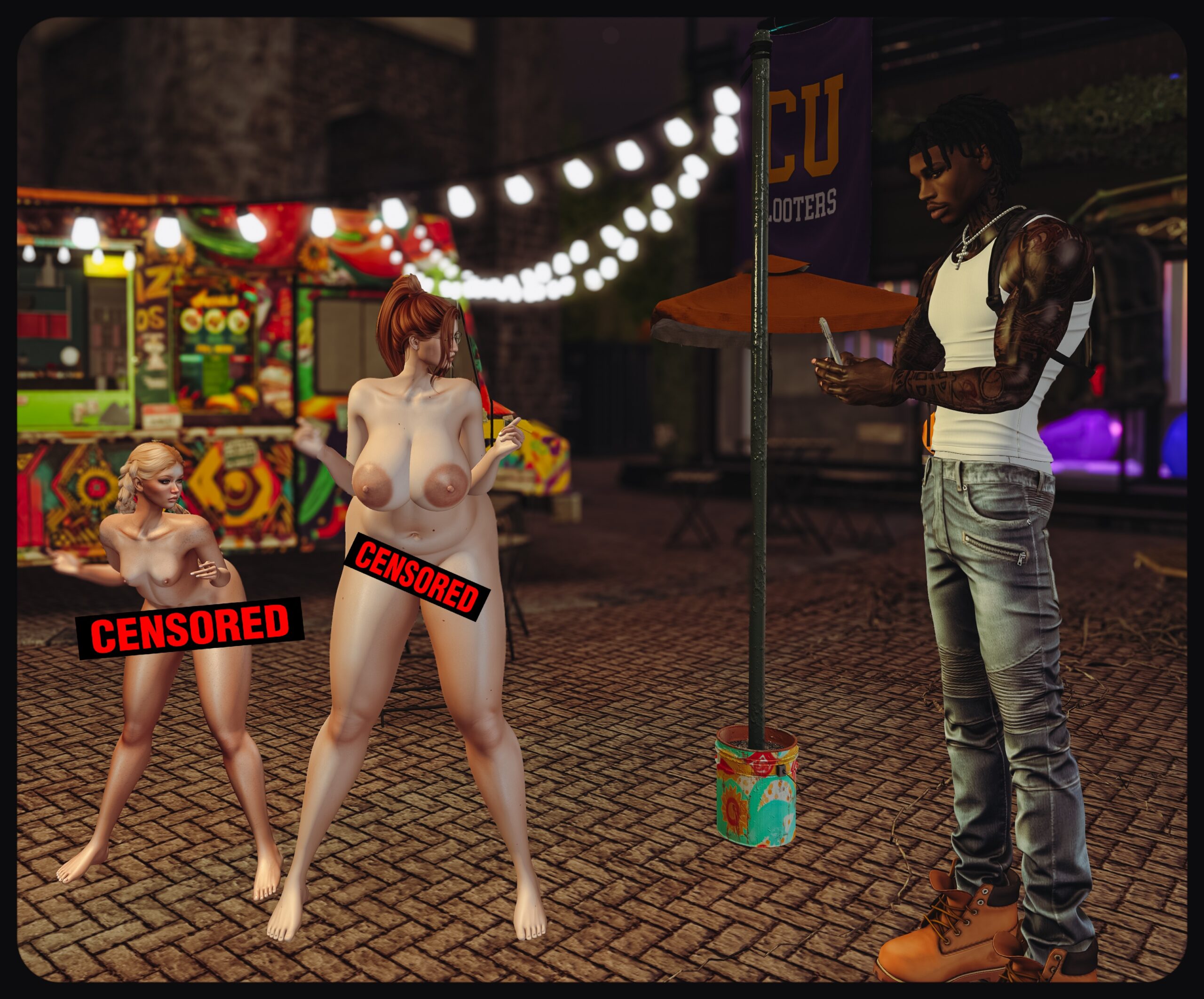
Around roughly the same period, Donovan Richards began losing his battle with clothing. By the time Witchouse were playing, people around the crowd were reacting to him being naked and Aphrodite Aquila-Karras was confronted with rather more Donovan than anyone had purchased a ticket to see.
There are photographs. There will not necessarily be published photographs. The Hathian Observer maintains standards. I appreciate them even if I do not publish them.
Sexual Dignity
Sexual dignity elsewhere was not dramatically healthier. People ground against one another beside wine stalls, kissed in crowds, slapped assorted backsides, climbed into laps and generally interpreted festival atmosphere with considerable physical enthusiasm. Hanwi, Clivia and Liza produced enough activity around the Lush Leaf van that I briefly considered invoicing them for competing entertainment and my wife for apology presents. Roman spent portions of the day twerking in inflatable beachwear and smacking people on the arse.

This isn’t a complaint.
Mostly.
Inflatables
The inflatables deserve recognition in their own right. Ducks, floaties, skeleton-panda constructions and other things that made perfect sense after three drinks migrated around Batterie all day. Mollie spent enough time encased in one that she occasionally seemed less like a festival attendee and more like a mobile attraction.

My camera crew naturally documented this important cultural development. By eleven forty I’d already photographed duck rings, Mollie’s inflatable and Hanwi’s party attire and described the entire beach, quite correctly, as a feast for the camera.
Then There Was HPD…
Vanora had arrived early enough to demand Fitz’s permits, as already noted. By the standards of police procedure, the negotiation that followed was unconventional but interesting. Fitz questioned whether Vanora possessed permits for her breasts; Vanora assured him that she did; Fitz eventually climbed down from Crack Rock and presented her with VIP passes which he optimistically described as “my permits.”


Later I instructed the Observer crew to obtain a proper zoom photograph of the lieutenant’s summer uniform.
Journalism sometimes requires sacrifice.
Mine was having to check the photograph afterwards. 🙂
Vanora’s afternoon became stranger still when Fox attempted to slip one of the little sample bags into her handbag unnoticed. Vanora stepped backwards at precisely the wrong moment and Fox instead got a handful of lieutenant.
The immediate response was approximately what you would expect. The subsequent explanation involved repeated clarification that Fox had been trying to put something in the handbag, not anywhere anatomically creative. Vanora eventually sealed the mysterious packet into an evidence bag, which may be the closest Crackchella came all day to conventional police work.
Daiyu’s Camera Roll
Not every photograph needs to interrupt the story. Some of them can simply prove that, yes, all of this really did happen.


Open the rest of Daiyu’s Crackchella camera roll


So… Did Crackchella Actually Work?
When Isla finally stepped offstage shortly after half past seven, her legs gave out, Gavin caught her and Crackchella’s musical programme was over. Fitz celebrated by throwing a barricade at the stage before somehow becoming serious long enough to thank everyone who had turned up and declare: “We might be garbage humans but we know good music, we know ENTERTAINMENT!” Annoyingly, he had a point. Crackchella worked, and not merely by Hathian standards. It had a proper stage, vendors, merchandise, food, booze, DJs, a full band, solo performers, original music and enough people sticking around for hours that it genuinely felt like a festival rather than a beach party with ambitious speakers.
Was it perfect? Obviously not. The schedule wandered, security were handing out drugs, one attendee got punched, another climbed onto a roof carrying a woman and Donovan misplaced the concept of trousers. None of it stopped the event and, unfortunately, most of it made the success feel more authentically Hathian. Fitz finished by advertising himself as someone capable of turning around other people’s projects, citing the fact that a man who had apparently “shit in the bakery a few months ago” had nevertheless managed to organise all this. I hate to reward that sort of behaviour, but against several entirely reasonable expectations, Crackchella 2026 worked. So yes, Fitz. You did it. Please don’t become unbearable about it.